

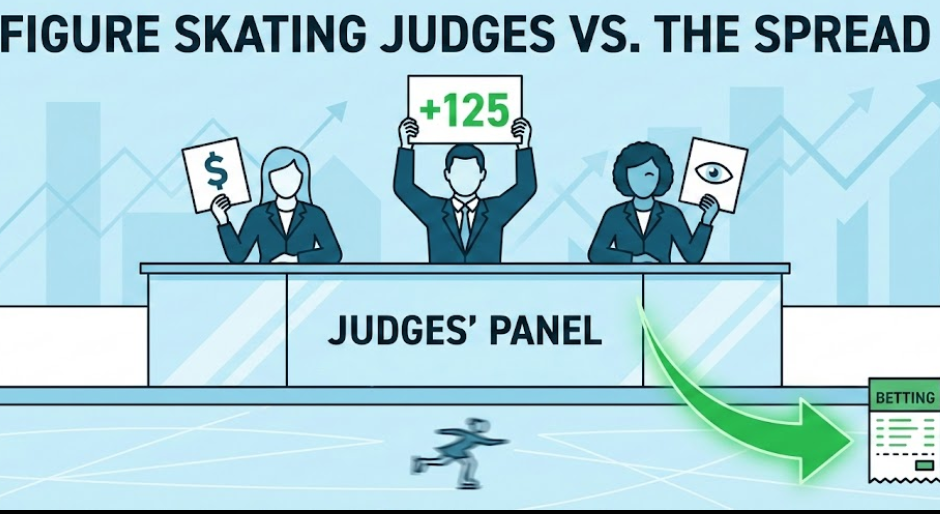
Don’t watch the skaters. Watch the people holding the pencils. If you are betting on figure skating by analyzing quad rotations, edge quality, or costume sequins, you are doing it wrong. You are trying to bet on a sport when you should be handicapping a political election.
In the rough-and-tumble world of sports betting, we usually hunt for hard metrics. We want yards per carry. We want three-point percentages. We want goalie save rates. But in figure skating, the most valuable stat on the board does not take place on the ice. It takes place behind the glass, where nine judges decide who gets the gold and who gets the gate.
Below is our list of online bookmakers that are a great fit for figure skating betting. We’ve vetted and reviewed each one, and they usually offer up-to-date odds across popular markets like outright winners, podium and top-3, head-to-head matchups, and total score over/under:
 US
US


For the sharp punter, the subjective nature of figure skating isn't a bug. It is a feature. It is a massive market inefficiency driven by human nature, national alliances, and "reputation scoring." Here is how to stop sweating the jumps and start exploiting the judges.
The Home-Ice Inflation Index
In the NFL, home-field advantage is worth about three points. In figure skating, "home ice" is a license to print money.
When a major Grand Prix event or Championship lands in a skater’s home country, the scorecards invariably drift upward. This isn't necessarily a conspiracy. It is psychology. The crowd roars for a simple Level 3 spin, and the judges unconsciously ride that wave of endorphins. They tap +2 on the Grade of Execution (GOE) instead of a +1. Over 12 elements, those tiny nudges add up to a massive gap.
The Sharp Angle: Forget the Moneyline and attack the Total Points markets. The public loves to bet the home favorite to win, crushing the value on the outrights. However, books often set the Over/Under based on the skater's average season performance at neutral sites. They rarely account for the "home cooking" inflation that can add 5 to 10 points to a total score. If a skater is on home ice, or even on the ice of a friendly neighboring nation, look hard at the Over.
The "Tenure Bonus" (Reputation Scoring)
Figure skating operates on a hierarchy that would make the mafia look democratic. Rookies have to prove they belong. Veterans have to prove they don't.
This is known as "Reputation Scoring." When a defending World Champion stumbles out of a jump or slightly under-rotates a quad, judges often give them the benefit of the doubt. They assume the quality was there because it usually is. Conversely, if an unknown teenager lands the same jump with the same minor flaw, they get hammered with negative GOEs. It is the same logic as an NBA superstar getting the foul call that a rookie never gets.
The Sharp Angle: Hammer the Head-to-Head matchups. When an aging favorite is up against a surging rookie, the market often overreacts to the rookie's recent practice reports or viral YouTube clips. Stick with the veteran. In a close call, the tie goes to the tenure. The judges are terrified to dethrone a king or queen unless the disaster is undeniable.
The Geopolitical Matrix
This is the bread and butter of skating handicapping. Judge panels are drawn from a pool of eligible nations. Before you place a single wager, you need to find the specific list of judges for the event.
Historically, specific "blocs" support each other. You see high scores exchanged between geographically or politically aligned nations. While the modern scoring system drops the highest and lowest scores to curb blatant cheating, it cannot stop a general trend. A panel dominated by Western European judges often favors "artistic" transitions. A North American panel might reward pure athleticism and jump height.
The Sharp Angle: Count the flags. If a Japanese skater is competing and the panel features a Japanese judge plus two judges from friendly federations, that skater has a statistically significant safety net. Their "floor" is higher. If that same skater is competing in Europe with a panel dominated by EU judges, their margin for error evaporates. Adjust your handicap accordingly.
The Component Score Cushion
Technical scores (TES) are math. You land the jump, you get the points. Component scores (PCS) are vibes. This is where the "creative interpretation" lives.
High PCS scores are incredibly sticky. Once a skater earns a reputation for being an "artist," they tend to receive high component scores even if they skate like a zombie on a specific night. This acts as a firewall for their total score.
The Sharp Angle: Fade the Under on "Artistic" Skaters. Avoid betting the Under on high-profile artistic skaters, even if reports say they are nursing an injury. A star skater can fall twice and still outscore a technician who skates clean. Why? Because the judges will give the star 9.5s in "Composition" and "Interpretation" for merely standing up and looking sad during the slow part of the music.
Stop treating figure skating like a 100-meter dash. Treat it like a reality TV show where the producers have a preferred winner. The smart money doesn't just watch the warm-ups. It reads the bios of the people holding the pencils.
If you can predict the bias, you can predict the score. In this sport, the bias is the only thing that never slips on the ice.