




Every March, millions of Americans collectively lose their minds. They hand over twenty dollars to an office manager named Susan. They spend hours agonizing over whether a 12-seed from a conference they have never heard of will upset a 5-seed they haven't watched all year. They convince themselves they have a "system."
Then, three weeks later, Susan wins the pot because she picked teams based on which mascot was cuter.

If this sounds familiar, I have some bad news. You are playing a game you cannot win. The NCAA Tournament bracket is a lottery ticket disguised as a sports competition. The odds of picking a perfect bracket are 1 in 9.2 quintillion. You have a better chance of being struck by lightning while winning the Powerball.
Stop donating your money to the office pool. If you want to actually profit from March Madness, you need to stop predicting the future and start betting on the present.
The Problem with "The Big Dance"
The bracket forces you to be right 63 times in a row. It is a parlay that spans three weeks. If your champion loses in the second round, your entire investment is dead. You spend the rest of the tournament watching games with zero financial interest. That is boring. And it is bad strategy.
Smart money doesn't care who cuts down the nets in April. Smart money cares about who covers the spread this Thursday afternoon.
The Single-Game Advantage
When you bet on a single game, you remove the chaos of the unknown future. You don't need to know if Duke has the depth to survive six games. You only need to know if they can beat Vermont by more than 14 points on a neutral court.
That is a solvable problem.
The bookmakers are good, but they are not gods. During the regular season, they can laser-focus their lines because there are only a handful of big games. But in the First Round of the NCAA Tournament? There are 32 games in 48 hours.
This is the only time of year where the volume of games overwhelms the oddsmakers. They cannot price every single matchup perfectly. They inevitably leave value on the table, especially in the games involving small schools like Colgate or Furman that the public ignores.
Target the Thursday/Friday Chaos
Here is your new strategy. Instead of putting $20 into a bracket pool where you are competing against 50 people for one prize, take that $20 and split it across four single-game bets in the Round of 64.
Look for the "ugly" games. The public loves to bet on the big TV matchups. They hammer the favorites in the primetime slots. This inflates the lines.
But nobody is rushing to bet on a 1:00 PM tip-off between a defensive-minded SEC team and a slow-paced Ivy League champion. The line on that game is likely softer. It is likely more accurate. And it is where you can find your edge.
Variance is Your Friend (In Small Doses)
In a bracket, one bad bounce destroys your entire month. In single-game betting, a bad bounce is just one loss. You can recover in the next game starting 20 minutes later.
This approach keeps you in the action. You are not eliminated on Day 1. You can adjust. You can see which teams are playing well and which teams are nervous. You can use live betting to hedge your positions. You have control.
Your Move
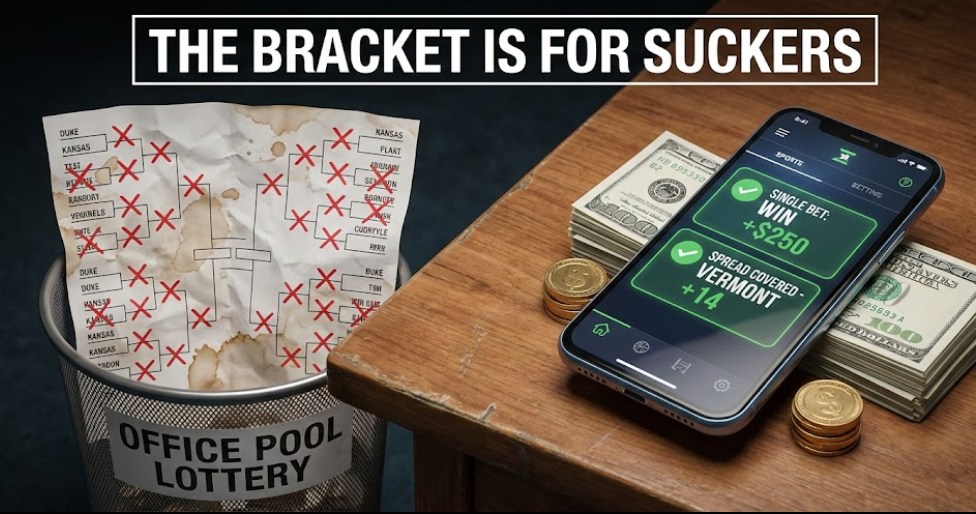
Tear up the paper bracket. Use it as a coaster. Tell Susan you are out this year.
Open your sportsbook app. Look at the spreads for the first Thursday. Find a team getting too many points because nobody respects their conference. Bet on them.
Winning an office pool gives you bragging rights until Monday. Grinding out a profit on game spreads gives you a bankroll you can actually use. Be a bettor, not a guesser.