





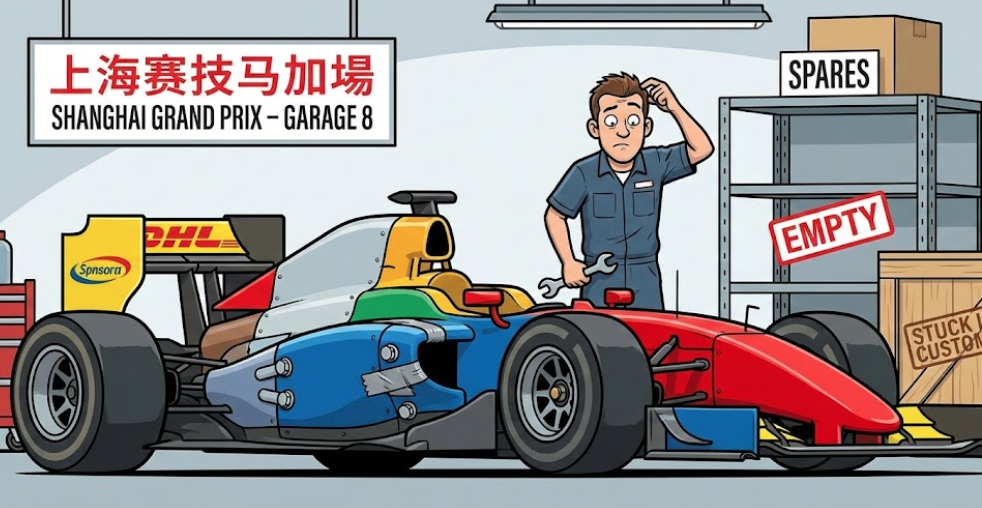
The champagne in Melbourne tastes fantastic on Sunday afternoon. Packing up 60 tons of highly sensitive freight four hours later does not taste fantastic. It tastes like jet fuel and panic.
The back-to-back sprint from Australia to China is the most brutal logistical hurdle of the year. Most punters look at the driver line-ups and assume everyone is arriving in Shanghai with brand new machinery ready for peak performance.
That assumption will lose you money.
The reality of the early season flyaway races is that the cars are patchwork. The "Shanghai Surprise" isn't about who has the fastest wind tunnel data. It is about who has the most spare parts available and who is terrified of crashing. Here is how to bet on a race defined by logistical anxiety.
The "Frankencar" Reality
The cars rolling out of the garage in China are rarely the optimized versions the engineers dreamed up back at the factory. The preferred upgrades are often stuck in customs or on a cargo plane somewhere over the Indian Ocean.
Teams are forced to dig into their "flyaway kits." This means using older specification parts that are slightly heavier or less aerodynamically efficient because the new stuff hasn't arrived yet. You are not betting on peak engineering here. You are betting on inventory management.
If a team brought major upgrades to Australia and smashed them to pieces on a curb, they are likely reverting to testing-spec parts for China. That is a massive performance downgrade that the bookmakers’ algorithms often miss in the opening rounds.
The "Do Not Crash" Tax
Nothing terrifies a team principal more in week two than a driver who bins the car in Free Practice. Spare parts are critically low this early in the year. If you only have three spare front wings for two drivers, the instructions over the radio are very clear: do not take risks.
This forced conservatism changes how you should bet. Drivers on teams with low stock are less likely to divebomb into Turn 14 for a meaningless 11th place. They will protect the equipment.
Look closely at the Driver Prop markets. If a driver is known for being aggressive but is in a team struggling with spares (like Williams or Haas often are early on), take the "Under" on their finishing position. They are driving with one hand tied behind their back by their own accountants.
Fading the Desperate Midfield
The gap between the rich teams and the poor teams is widest when logistics get messy.
If Max Verstappen needs a new floor, Red Bull can practically charter a jet to fly one in from Milton Keynes overnight. If a backmarker team needs a new floor, they are gluing the old one back together.
This is where the Head-to-Head (H2H) market value lives. Analyze the damage reports from Australia. If a midfield team had a messy, crash-filled weekend in Melbourne, fade them immediately in China against a similarly ranked team that had a clean weekend. The team that crashed is likely running repaired parts held together with hope, while the clean team has their best inventory available.
The Cold Shanghai Truth
The Shanghai International Circuit is a front-limited track that eats tires, and the weather is usually crisp in March. Getting heat into the rubber is a nightmare even with a perfect setup.
Trying to get tires into the operating window with a compromised, patchwork car running a "safe" setup is nearly impossible for the bottom half of the grid.
Expect massive time gaps to open up. The elite teams will manage. The desperate teams will fall off a cliff. Instead of betting on who wins, look at winning margin markets or betting against both cars from a struggling team finishing in the points.
The early season isn't a speed contest. It is a supply chain battle. Bet accordingly.